Coming as I do from South Africa where I was born and lived for over half a century, I am acutely aware of the White South African tendency to think, speak and write from within a White mental framework, even as they live and work in an overwhelmingly Black country. South Africa though is in some key respects a remarkable microcosm of the world as a whole, and this is one of them: when we in the blogosphere write, many of us do so with a clear mental bias to the USA and Europe, paying scant attention to the remarkable advances elsewhere, notably in Latin America.

How do we explain this paradox of rapid political gains in a region where open intolerance and clear homophobia remain entrenched? What can we learn? Writing in Americas Quarterly (and reprinted at Huffpost, where I came acr0ss it) Javier Corrales has some thoughts on the political processes, which I will get to. First, I want to reflect on the significance to us in the Churches, that he is referring here to Latin America, the home of liberation theology.
Liberation theology, which was born in the slums of Latin America, had major impact on progressive thinking in the years before and immediately after Vatican II, until it met fierce resistance from the JPII/B16 partnership. The core ideas though, remain influential: that the Gospels are firmly on the side of the suffering and oppressed, and that by listening to their experiences, expressed in their own voices, the church can hear the Holy Spirit speaking to us for our times. Although the ideas emerged in the political context of Latin America, these ideas have also spread to other regions and spheres. They were hugely influential in South Africa, where the exponents were prominent in the long struggle for freedom, and also in Asia. It was also a formative influence on feminist theology, which in turn fed into gay and lesbian theology, and then queer theology. It is no coincidence that Marcella Althaus-Reid, one of the foremost exponents of queer theology (which she called "Indecent Theology"), came from South America. Her books exude the flavour and language of life in those Latin slums - and read like real life, far removed from the dry, distant theology that emerges from the Vatican ivory towers.
So, we as queer Christians have many lessons we can learn from the liberation theology of South America. Here is an edited summary of what Cabral has to say about the secular, political lessons:
From America Quarterly:
When most straight people are forced to think about gay people, they usually think of one thing first, sex. A political scientist might focus instead on a different question: how do gays perform in politics? Judged from their political achievements this past decade, the answer is, at least for Latin American gays: they're pretty good.The political achievements of LGBT groups in Latin America in the 2000s are remarkable. Examples include: decriminalization of homosexuality (now complete in all Spanish-speaking countries and Brazil); laws against sexual-orientation discrimination (Brazil 2000, Mexico 2003, Peru in 2004); extending the same rights and obligations to same-sex couples as heterosexual couples (e.g., Buenos Aires 2002, Colombia in 2009); granting access to health benefits, inheritance, parenting and pension rights to all couples who have cohabited for at least five years (Uruguay); and constitutional bans against discrimination on the basis of gender, sexual identity or HIV status (Ecuador 2008). In the last two years alone the speed of change picked up, with most countries witnessing a significant legal change in the direction of more gay-friendliness, including the now famous Mexico City law recognizing gay marriage and adoption rights. [Please see index of chronology attached.]
Appropriately, he points to some specific lessons we can draw on methods to employ (emphasis is mine):
1. Embrace, not hate, globalization. Whereas the traditional left in Latin America has never quite come to terms with globalization, always responding to it with various forms of negativity ranging from suspicion to extreme repulsion--LGBT movements have adopted a more relaxed response: leverage globalization. LGBT groups systematically use resources provided by globalization and markets to enhance their bargaining leverage.2. Party hard. A major mistake made by Latin American leftist social movements in the late 1990s was to disdain all things partisan. This generated a lot of unnecessary bad blood between parties and social movements that resulted in too much misallocated energy that helped neither group. LGBTs don't seem to display this hostility toward parties.3. March hard. Like good old leftists, LGBT groups understand the power of a massive protest, especially in the streets. But their approach to taking the streets is not to go on strike, interrupt traffic during rush hour, shut down schools and hospitals, or vandalize private property, but rather, throw an annual gay pride march.4. Wage wars peacefully. LGBT groups are engaged in an epic battle against homophobia. Like good old feminists, they are in a life-long struggle on behalf of gender and sexuality rights, and like good old human rights groups, they want equal treatment for all. But LGBT groups avoid two excesses associated with die-hard feminist and human-rights groups. They avoid launching wars against men in general, a problem that besets many feminist claims, and they avoid adopting too punitive an agenda.5. Think anti-establishment; act intra-establishment. Like good old radicals, LGBT groups are motivated by anti-establishment, even utopian goals. To hope for a world free of homophobia has got to be one of the most idealistic goals of our times, and yet, all LGBT groups are committed to nothing less. LGBT political groups are thus as radical as they come. But their approach to changing the status quo is not exactly all that radical. Rather than destroy the status quo, they seek to work the status quo.6. In battling conservatives, be fiercely conservative. The most significant development of LGBT politics in the Americas in the 2000s was the eruption of the marriage issue. This was never the top preference of LGBT groups, neither in the United States, where this issue began, nor in Latin America, where this issue has since become quite central in some of the larger countries. In terms of things for which to fight, LBGT across the Americas in the early 2000s would have preferred different battles, such as workplace discrimination. But LGBT groups immediately discovered the political advantage of embracing the marriage issue. It gave them a conservative argument to use against their conservative foes.7. Draw business lessons. LGBT groups are succeeding in politics also because they are drawing lessons from the business world. From the ad industry, to give one example, LGBT groups have drawn the lesson that nothing sells like the creation of status symbols. Thus, LGBT groups have created the notion that being pro gay is a symbol of being modern, cosmopolitan, and hip.8. Pop! Pop Culture is the new Populism. Like good political strategists, LGBT movements understand the advantages of appealing to all sectors of the population, and specifically, to both the privileged and the underprivileged. The old left in Latin America tries to create this cross-sectoral political alliance by promising too much from the state, a strategy that often flops and disappoints. LGBT groups have developed a less error-prone approach. They use pop culture as the new populism.9. This revolution will be YouTubized. LGBTs not only do well as shapers of pop culture, but also as users of the latest medium to transmit pop culture: YouTube. Anytime there is an LGTB-related video out there, LGBT groups share it with hurricane force. Thus, a video about a hate crime in San Juan, or a video of a gay wedding in Argentina, or a video of a homophobic declaration by a bishop in Mexico is instantly watched and deconstructed in the LGBT cyber world.10. The next gay revolution: Liberté, egalité, (p)maternité. The next LGBT revolution will not only be YouTubized, but it will also involve another remix of traditional and non-traditional icons of the Western world. LGBT groups know that their ideological forté is to focus on old-fashioned principles of the Enlightment--liberty and equality. Much of their success stems from their refusal to privilege one principle over the other, as the hard left and hard right often do, but rather, to always portray the fight for LGBT rights as a struggle for freedom and equality simultaneously. LGBT in the Americas are now launching their next struggle--the fight for p/maternal rights. Once again, they will use iconic emblems (liberty and equality) to transform a traditional aspiration of humans (the desire to raise a family) into a new democratic right: the right of LGBT people to adopt children.In sum, what we have here is more than just amateurish politics. Like few other leftist social movements, LGBT groups have developed ingenious responses to some of the most pressing issues of our time: unrestrainable globalization (exploit it), strained political parties (respect them), unevenly-performing democratic institutions (fix them and work with the fixed ones), rising religiosity (talk the language), political cynicism (mobilize the young), attention deficit disorder for the written word (YouTubize everything), machismo and homophobia (rebrand the concept of gayness), increasing corporatization of citylife (buycotts). Most members of LGBT groups started out feeling ostracized, but they responded by working the system and building alliances with the system's untouchables. Because they are ideologically on the left and yet their responses to these challenges depart from traditional leftist responses, LGBT groups could very well be considered the first post-left leftists of the twenty-first century.The strategies of LGBT groups, as with all innovations, are neither infallible nor immune to criticism. There is an inherent contradiction, for instance, in a movement that fights for equality by simultaneously relying on status categories of hipness and cosmopolitanism, to mention just one problem. It is not entirely clear either that all these strategies are especially impactful or appropriate for low-income communities. No doubt, philosophers have ample material here for debate in the years to come.But there is no question that LGBT groups are emerging as the superstars of politics. Their approaches are succeeding in unexpected ways, especially considering the odds against them. LGBT groups will not win all their battles, but they have already revolutionized the way we ought to think about effective contestation in twenty-first-century democracies. As in so many other domains, LGBT folks in politics have proven to be, yet again, epochal trend-setters.
Read the full article at: Americas Quarterly.
APPENDIX : LGBT Victories in Latin America 2008-2009:
- - February 2008 - Venezuela. The Constitutional Branch of the Supreme Court issues a ruling that, on the one hand, recognizes that discrimination against sexual orientation is unconstitutional, but on the other hand, states that there does not exist constitutional protection for same-sex partnerships; only the legislature can confer such protections.
- - March, 2008 - Nicaragua. A reform of the Penal Code legalizes same-sex relations and ends an anti-sodomy law.
- - March 2008 - Brazil. Police estimate that more 3 million people participated in the 12th annual Gay Pride March; both the Sao Paulo government and Petrobras sponsor the march.
- - June 2008 - Brazil. President Lula launches the "First National Conference of Gays, Lesbians, Bisexuals, Transvestites and Trasnsexuals in Brasilia.
- - June 2008 - Cuba. New president, Raúl Castro, authorizes offering free sex-change operations for qualifying citizens, a policy change advocated by Cuba's National Center for Sex Education (presided over by President Raúl Castro's daughter, Mariela Castro).
- - August 2008 - Panama. Government repeals a 1949 law criminalizing gay sex.
- - September 2008 - Ecuador. Voters approve the country's 20th constitution. Article 11 bans discrimination on the basis of "gender identity," "sexual orientation," and "HIV status" (but still defines marriage as the "union between man and woman," Art. 68).
- - December 2009 - United Nations. The United Nations General Assembly affirms that international human rights protections include sexual orientation and gender identity. The statement is read to the Assembly by Argentina; 12 of the 66 countries that signed on were Latin American.
- - January 2009 - Mexico. In a unanimous vote, the Supreme Court rules in favor of a man-to-woman transsexual requesting the reissuing of a new birth certificate that would not reveal the change in her sexual identity.
- - January 2009 - Colombia. The Constitutional Court upholds a lower court opinion that same-sex couples must be accorded the same benefits as heterosexual couples in common-law marriages. This ruling grants same-sex couples equal pension, survivor, immigration and property rights.
- - February 2009 - Bolivia. New constitution bans discrimination on the basis of "sexual orientation" and "gender identity" (but only recognizes "marriage" and "free unions" as occurring "between a woman and a man").
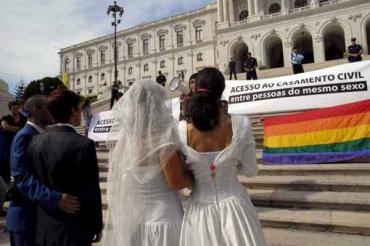
- - February 2009 - Chile. The Unified Movement for Sexual Minorities (MUMS) organizes the first-ever mass wedding for sexual minorities in front of the Metropolitan Cathedral.
- - September 2009 - Uruguay. With a 17-6 vote the legislature approved a bill that ends restricting adoptions to married couples, what many interpreted as paving the way for adoptions by same-sex couples. Earlier, Archbishop Nicolás Cotugno of Montevideo condemned the bill as going "against human nature itself, and consequently, ... against the fundamental rights of the human being as a person."
- - November 2009 - Argentina. A Buenos Aires judge ruled that it was unconstitutional for civil law to stipulate that a marriage can exist only between a man and a woman. A marriage licence was then granted to Alex Freyre and José María Di Bello. This became the most controversial marriage in modern Argentine history, with debates on TV, marches, and hostile posters on billboards across the city. The archbishop of Buenos Aires, Jorge Bergoglio, publicly criticized the city's mayor, Mauricio Macri, for not appealing the judge's decision to grant the marriage licence.
- - December 2009 - Mexico. In a 39-to-20 vote with five abstentions, Mexico City's Legislative Assembly approved marriage rights for same-sex couples. In a separate vote, the Assembly also approved adoption rights by a vote of 31 to 24 with nine abstentions.
Source: Corrales, Javier and Mario Pecheny, eds. 2010. The Politics of Sexuality in Latin America: a Reader on Lesbian, Gay, Bisexual and Transgender Rights. University of Pittsburgh Press.