My Sites

Showing posts with label Marriage Equality. Show all posts

Friday, 18 February 2011

Hawaii Civil Unions Approved; Marriage Equality Update

Three significant news items yesterday illustrated the continuing momentum towards marriage and family equality.

In Hawaii, the state senate has now given final approval to civil unions for same sex couples. All that is now required is for the Gobvernor to add his signature, which he has promised he will do, adding to the number which now offer marriage equality or near equality at state level. More will follow.

In Baltimore, another state senator has stepped off the fence, and announced he will vote in favour of the marriage bill next week. This makes at least 24 votes (and possibly 25) in favour, which will be enough for approval. Passage in the lower house and the governor's signature should follow.

In Delaware, a new group (Equality Delaware) has been formed to push for civil unions, and has announced sponsors for a bill to be introduced to the legislature later this year. (A recent opinion poll showed that a plurality of Delaware voters support full marriage. This would suggest that the early prospects for the more cautious proposal of civil unions must be good).


For the record, here is the current rundown by state, for the US a.nd internationally.

Saturday, 29 January 2011

Civil Unions Now Imminent in Hawaii

The Hawaii state Senate yesterday approved civil unions legislation for the state. Approval by the state House, which last year passed similar legislation before it was vetoed by GOP Governor Lingle, is surely just a a formality. The new governor, Democrat Neil Abercrombie, has already promised to sign the legislation when (no longer if) it reaches his desk. Near-marriage, marriage in all but name, is on the way in Hawaii.

In my mind, only three questions remain:
  • When will the new legislation take effect? How long will it be before Hawaii's same-sex couples will be able to tie the knot, and have their unions recognized by the state?
  • Which will be the next state to follow suit?
  • How long must we wait for "near-marriage" to  become full marriage equality, including the name?
From NECN:

Hawaii Senate approves same-sex civil unions

HONOLULU (AP) — The Hawaii Senate on Friday overwhelmingly approved civil unions for same-sex couples, a major step toward the proposal becoming law. 
The state Senate voted 19-6 for the bill, which now goes to the state House of Representatives, where a nearly identical measure passed last year before it was vetoed by then-Gov. Linda Lingle, a Republican.

Friday, 28 January 2011

New Yorkers Want Marriage Equality (Poll Shows Strongest Support Yet)

Even though New York Democrats lost control of the State Senate last November, the prospects for a bill providing for full marriage equality this year look brighter than ever - senators will know that in both parties, some of the most outspoken opponents lost their re-election bids (almost unheard of in state politics) and will not want to go the same way. Undoubtedly, some of those who voted against the last gay marriage bill will change their votes the next time around - we just don't know how many. For the waverers, this CBS6 Albany report of a new poll from  (highly reputable) Quinnipiac Research could help to sway them. Note that support for equality is strong in all geographic regions (suburban, NYC, and Upstate), and that 41% of Republican voters are also supportive. Note also that the gap between support and opposition has doubled in just 18 months, going from 10% in June 2009 to 21% this month.

Friday, 7 January 2011

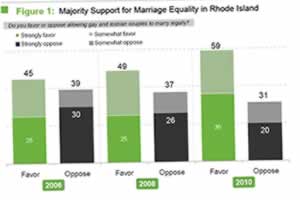
Bills to legalize gay marriage introduced in R.I. House, Senate - ProvidenceJournal

With the introduction on Thursday of same-sex marriage bills in the House and Senate, the battle now begins.
In the House, Rep. Arthur Handy, D-Cranston, introduced his annual bill to legalize same-sex marriage in Rhode Island. The 29 lawmakers cosigning the bill include House Speaker Gordon D. Fox.
As she introduced similar legislation in the Senate, Sen. Rhoda Perry, D-Providence, said she hoped it would get a hearing and vote early in the legislative session.
A mirror of Handy’s bill, it legalizes “civil marriage” between people of the same gender to marry, while specifying that no religious institution would be required to marry same-sex couples if it goes against its teachings.

“We want to get it going early on,” she said. “We want to have debate and a hearing, and we do not want to wait until the end of the year.”
The legislation has strong support in the House, where Fox, who is openly gay, has also expressed his desire for an early vote.
Read more at Providence Journal
Related:

Sunday, 24 October 2010

Australians Support Marriage Equality, Opposition Waning.

In common with other countries, support for legal recognition of same sex marriage in Australia is increasing. Support is now at 62%, up from 60% a year ago. The only age group which does not yet show majority support is the over 50's - but only just. Even this group has support at 46%. The youngest group of Australian adults polled are overwhelmingly in favour: 80% agree with the prospect. Politically, only the misnamed "Liberal" party are against, while 75% of Labour voters are in favour. Why Labour PM Julia Gillard continues with her resolute opposition is entirely beyond me: the indications are that this issue has already cost her votes in the last election, resulting in increased seats for the Greens and Independents. As the independent MP Andrew Wilkie has stated, she is clearly out of step with her own voters.

From the Sydney Morning Herald:


Findings from a new poll of 1050 respondents came as the independent MP Andrew Wilkie called on the Prime Minister, Julia Gillard, to move on the issue, saying she was ''out of step with the people''.

Mr Wilkie said the Prime Minister should allow a conscience vote, saying it was "beyond time for the Parliament to start representing the people".

The Galaxy poll showed support for same-sex marriage increased from 60 per cent of respondents in 2009 to 62 per cent this year.

The survey, which was conducted over two days earlier this month, showed uniform support for a conscience vote across party lines with 80 per cent of Labor and 75 per cent of Liberal voters agreeing to the idea.

While supporting a conscience vote, Liberal voters were much less likely to agree to allow same-sex couples to marry, with less than half supporting the change. Nearly three-quarters of Labor voters and four out of five Greens voters support same-sex marriage.

The survey also shows that younger Australians are more likely (80 per cent) to support same-sex marriage than those aged over 50 years (46 per cent).


Enhanced by Zemanta

Tuesday, 21 September 2010

What Constitutes a “Family”? Empirical Study Finds A Wider View

Religious conservatives are regularly referring to the “traditional family” as a foundation for their beliefs, but there is no such thing. The conservative interpretation of the so-called traditional family is  a relatively modern invention, created to fit the conditions of the nineteenth and twentieth centuries in Western Europe and North America. In earlier times, and other parts of the world. family structures varied enormously from  this particular model.

Family history, like all other history, is constantly changing to fit new circumstances, so it should be no surprise that conceptions of family in the twenty first century are continuing to evolve, to fit a world that is no longer what it was in the nineteenth and twentieth centuries. Some of these changes are obvious, but like so much that is familiar, can easily be “hidden in plain sight.” A new study by sociologist  Brian Powell brings this into plain view. (His study is specifically of American views, but with the emergence of a shared world culture, many of his findings will also have relevance across a much wider geographic region.)


The central finding is that people no longer define “family” as mom pop and kids, but also include   same-sex couples with children (Children seem to be central: childless couples, gay or straight, are not seen as “families”, but just as couples). However, there is an increasing movement towards acceptance. An important finding, familiar from previous studies on the subject, is that people who know gay people (more accurately, who recognize that people they know are gay), are more supportive than those who are not aware that family members or acquaintances are gay. This simply reinforces the necessity for the wider political struggle, that wherever possible, gay men and lesbians should come out openly, in as many contexts as possible. Coming out personally will improve acceptance in our circles of friends and family. Politicians and other public figures who come out   do so indirectly for the wider community.

I particularly liked an argument on gay adoption that I have been using regularly: framing arguments in terms of the “the best interests of the child” can work to our advantage, not those opposed to gay adoption. (In adoption considerations, the best interests of the child require placement with the best parents available. Sometimes, they will be gay).  Indeed, the claim made (but not elaborated on in the reports I have seen), is that the interests of children may well be a more effective argument than others in making the case for more general equality of same-sex couples.

A majority of Americans now say their definition of family includes same-sex couples with children, as well as married gay and lesbian couples.
At the same time, most Americans do not consider unmarried cohabiting couples, either heterosexual or same-sex, to be a family — unless they have children.
The findings — part of a survey conducted this year as well as in 2003 and 2006 by Brian Powell, a sociology professor at Indiana University, Bloomington — are reported in a new book, “Counted Out: Same-Sex Relations and Americans’ Definitions of Family,” to be published on Wednesday by the Russell Sage Foundation. Since the surveys began, the proportion of people who reported having a gay friend or relative rose 10 percentage points, said Professor Powell, the book’s lead author.
“This is not because more people are gay now than in 2003,” he said. “This indicates a more open social environment in which individuals now feel more comfortable discussing and acknowledging sexuality. Ironically with all the antigay initiatives, all of a sudden people were saying the word ‘gay’ out loud. Just the discussion about it made people more comfortable.”
The book concludes that framing the equality of same-sex couples in terms of “the best interests of the child” might prove to be a more successful political argument than others.

Second Poll Confirms: US Majority Support Gay Marriage.

When a CNN poll last month showed for the first time that a majority of Americans supported gay marriage, I was a little cautious. A single poll can always be an aberration, the wording was unusual, and the small tiny (in a split sample, just 250 - half of a sample of 500). However, a new poll with more conventional wording and a more robust sample has produced an almost identical result: 52% support full marriage equality (and 46%
 against, with only 2% "don't know").

Thursday, 2 September 2010

Oz State Premier Stands Up To Cardinal Pell, Secures Gay Adoption for NSW.

Breaking news today is that the New South Wales state assembly has narrowly approved a bill to put LGBT and heterosexual couples on an equal footing for adoption procedures. There are still a few hurdles to clear before this becomes final, but (as far as I can tell), with this one, the biggest has now been cleared. This is big news for queer Catholics. The formidable Cardinal Pell made clear his strong opposition - but the equally strong support of the Catholic NSW Premier, Kristina Keneally, appears to have been decisive in providing just enough resistance.
Kristina Kenneally, Catholic and Advocate for Adoption Equality

Friday, 6 August 2010

Gay Marriage: The Fallacy of the Church’s Argument Against.

Writing in El Paso Times, Texan priest Fr Michael Rodriguez has launched an impassioned diatribe against all forms of legal recognition for same sex union. His ranting could easily be dismissed as the lunatic fringe, but as so many Catholic catechismophiles share his ridiculous claims and assumptions, I think it is worth responding in full. This is his key assertion:
Remember: Every single Catholic, out of fidelity to charity and truth, has the absolute duty to oppose (1) the murder of unborn babies, and (2) any and all government attempts to legalize homosexual unions.” 
Not content to invent a supposed moral obligation to oppose all forms of union, he goes even further:
“Any Catholic who supports homosexual acts is, by definition, committing a mortal sin, and placing himself/herself outside of communion with the Roman Catholic Church.”
Furthermore, a Catholic would be guilty of a most grievous sin of omission if he/she neglected to actively oppose the homosexual agenda, which thrives on deception and conceals its wicked horns under the guises of "equal rights," "tolerance," "who am I to judge?," etc.
What has he been smoking? He claims to base his words on a pastoral letter of the US bishops, which says, in part:
"It is not unjust to oppose legal recognition of same-sex unions, because marriage and same-sex unions are essentially different realities. The denial of the social and legal status of marriage to forms of cohabitation that are not and cannot be marital is not opposed to justice; on the contrary, justice requires it."
Now I disagree with the bishops’ stance, but it as least an understandable, coherent position. It’s a big leap, though, to go from “it is not unjust to oppose…”, to saying that there exists an “absolute duty to oppose …“
He attempts to soften his position by stating
I urge all of the Catholic faithful to treat homosexuals with love, understanding, and respect.
In doing so, I fear that by his own standards, he damns himself. He has already insisted that a Catholic “would be guilty of a most grievous sin of omission if he/she neglected to actively oppose the homosexual agenda”. I have never been clear precisely what this notorious “agenda” comprises, but as one who actively promotes it, I am certain that a central part of it is precisely a demand to be treated with dignity, compassion and respect. By urging this part of it, Fr Rodriguez is himself promoting a key component of our “agenda”, and by his own standards is thus committing a “grievous mortal sin”.

By his standards, he also condemns not just himself, but the majority of US and European lay Catholics, and also a significant proportion of the clergy and some bishops. How so? He claims that Catholics have an obligation to actively oppose the homosexual agenda. But numerous (US) research surveys have shown that a narrow majority of Catholics approve of same sex marriage and gay adoption, while more substantial  majorities approve some form of legal recognition, and do not see same sex relationships as being morally wrong. Among the clergy, some individual priests and groups of priests have publicly supported gay marriage, and many more privately support either marriage or civil unions. In Portugal, when the legal process that led to marriage equality first began, the country’s bishops attempted to prevent its introduction by asking for the provision of civil unions instead. As civil unions are one form of legal recognition which the bishops were actively promoting, where they too guilty of the “grievous sin” Rodriguez describes?

In April this year, the Cardinal Archbishop of Vienna, Christoph Schonborn, suggested that it is time for the church to reconsider its emphasis on “homosexual acts”, and instead consider the quality of the relationships. Since then three other bishops have said much the same thing. Are they too, condemned, for their “grievous sin”?

So, it would seem that Fr Rodriguez has taken it upon his own authority to condemn a huge proportion of the Catholic church for the grievous sin” of not actively opposing the homosexual agenda. Just what is he condemning us to? Read carefully, once again:
Any Catholic who supports homosexual acts is, by definition, committing a mortal sin, and placing himself/herself outside of communion with the Roman Catholic Church.”
He cannot be serious. This sounds like the same automatic excommunication recently invoked by the Bishop of Phoenix, and by the Vatican, in the cases of abortion and the “attempts” to ordain women. Is he really taking it on himself to proclaim the automatic excommunication  of half the church, and more?

Let’s be clear on this: It is certainly the collective desire of the the Catholic bishops that we should oppose same sex unions, but it is by no means a moral obligation to do so. Nowhere in orthodox Catholic teaching is there anything that says there is any moral obligation to do everything the bishops urge, and there most certainly is not anything in the Catechism, in the creed, or in our baptismal vows that imposes such a supposed obligation.

On the contrary, one obligation that is stated very clearly in the teaching of the Church, is the obligation to follow one’s conscience. This was stated very clearly by one Fr Joseph Ratzinger, who insisted that conscience must take priority even over the demands of the pope.

When approaching gay marriage from the prism of sexual ethics, many people may well find that the dictates of conscience may lead them to oppose it. But sexual ethics are not the only, or even the most important, dimension of Church teaching. Many Catholics believe that teaching on social justice, and reaching out to the poor and the marginalized, is more important. Approaching marriage equality from the prism of social justice, many Catholics have been led by conscience to conclude that they must support it. This was certainly the case with some of the Argentinean senators who supported their family equality bill, and with “Catholics for Marriage equality in the US”.

So, in focussing exclusively on the approach from sexual ethics, Rodriguez is ignoring a huge chunk of orthodox catholic teaching – on the primacy of conscience, and on social justice. He is also ignoring the evidence of history.

By insisting on the spurious claim of an obligation to oppose all forms of legal recognition, he is including civil unions – but civil unions are just that, legal contracts to provide some protections to the partners in a relationship. They are not about sexual relationships – partners wanting a sexual relationship can (and do) have one without requiring a contract to authorize it. And liturgical recognition of same sex unions has a long tradition in the church, as amply demonstrated by both John Boswell and Alan Bray . To this day, there are echoes of these same –sex unions in the modern Mass, with the paired names of Felicity and Perpetua, Phillip and Bartholomew incorporated into the Eucharistic prayer – just as they were listed in the liturgies for same sex unions. (No, these were not “comparable” to modern marriage – but nor are modern civil unions, and nor were the the early heterosexual marriages comparable to modern marriage.) To the cynics who insist that in practice, civil unions are about sex, I reply that they need not be. In the early church, many saintly married couples committed themselves to voluntary virginity, even within marriage. In the nineteenth century, Cardinal John Newman, who will be beatified next month, was famed for the intensity of his (celibate) love for his dear friend Ambrose St John, even to the extent of insisting on being buried with him in a shared grave “for all eternity”. For any Catholic of homosexual orientation wishing to live strictly within orthodox teaching, which clearly states that the homosexual “condition” is not sinful, this celibate emotional bond might well make a fitting model of emotional friendship. If two such people chose to share their lives together, in chastity, is it in any way conceivable that there is a “moral obligation” to oppose legal protection for their relationship?

Finally, Rodriguez even ignores  the evidence of the Gospels.

By His own words and actions, Jesus Christ clearly showed that He did not reject people in homosexual relationships. He demonstrated this by agreeing to heal the Roman centurion’s “servant” (“paidion”), in a context that would have strongly suggested a sexual relationship. This too, has an echo in the modern Mass – the prayer shortly before communion, “Lord, I am not worthy  to receive you….” is a close variant of the centurion’s reply when Jesus started off for his house “Lord.I am not worthy that you should enter under my roof…”.

There is additional echo of gay unions in the Mass. Taken as a whole, theologian Gerard Loughlin has shown how it is an echo of the wedding at Cana, a wedding which in Catholic theology, is taken symbolically to represent Christ’s own wedding to his (male) disciples, and to the Church as a whole – including the men. There is even a tradition that the couple getting married were Jesus and His beloved disciple, John.
With three distinct echoes of gay relationships or unions, the Mass itself, the centrepiece of Catholic practice can be seen as promoting the “gay agenda” – or that part of it which seeks inclusion in Church.

Will Fr Rodriguez now cease celebrating the Mass?


To simplify: One would have to be ghastly morally decrepit to think that if 51 percent of Americans opine that rape is OK, then rape becomes, in effect, all right. Sure, the majority is politically capable of such a vote, but this could never make rape morally right.


This is typical of the garbage from the institutional Catholic Church, who blithely ignore their own history, which is full of recognized saints. ordained bishops and even popes who have had sex with men. For centuries (over half its history), the church recognized formal liturgical rites for church blessings of same sex unions, and also buried some same sex couples together in shared tombs, exactly as married couples.
The Mass itself contains three echoes of gay unions - the healing of the Roman soldier's "paidion" - i.e., his sexual servant is recalled in the words, "Lord, I am not worthy"; same sex couples named in the Eucharistic Prayer; and the Mass itself is commemorates Christ's wedding to his Church (male and female). Theologian Gerald Loughlin has noted that one tradition was that the famous wedding was that of Christ to his "beloved disciple" John.

http://thewildreed.blogspot.com/2010/07/message-for-nom.html
Same Sex Unions
The Very Modern “Traditional” Marriage
Modern Inclusive Churches
The Queer Mass:
Gay Wedding at Cana
Same sex couples recognised
Gay Centurion.

Saturday, 31 July 2010

Argentina: The Weddings Begin

The first gay weddings under Argentina's new family equality law have begun. (These are not the first gay marriages- a handful of couples were able to sneak in by earlier court challenges and sympathetic magistrates, but these at the first to be arranged routinely under national marriage laws.  As you see, this was neither a traditional white wedding, nor a quiet affair in the registry office - there were too many reporters and photographers for that description. The couple are an actor and his agent - they will be used to the press, and won’t object to the publicity.
CNN reports:
Buenos Aires, Argentina (CNN) -- Two men who have been together for 34 years have become the first couple to obtain a same-sex marriage since it became legal in Argentina on July 15. Artistic representative Alejandro Vanelli and actor Ernesto Larrese were married in a civil ceremony Friday morning in Buenos Aires, Argentina's capital. They wore dark suits and striped blue ties and were surrounded by well-wishers and a throng of reporters, photographers and videographers. Larrese spoke to his partner -- but also to the nation at large. "To all those who are afraid ... those who are homophobic ... I tell them, don't worry; this doesn't affect you," Larrese said. "You have nothing to fear. Fear is the opposite of love. Any phobia can be cured with love. There is nothing love cannot cure.
However, the BBC says a different couple got in first, just an hour earlier, in a northern town.  Who cares? There will be many, many more.
An architect and a retired office administrator have become the first gay couple to marry in Argentina under a new law legalising same-sex marriages. Miguel Angel Calefato, 65, and Jose Luis Navarro, 54, have lived together for 27 years. Argentina is the first Latin American country to legalise same-sex marriage. The law was passed after a long and often bitter campaign and it still faces opposition, most notably from the Roman Catholic Church. After the early-morning ceremony in the northern town of Frias, Mr Calefato and Mr Navarro promised to hold a big party to thank all who had supported the passage of the law.
The couple have been together for 27 years

Monday, 26 July 2010

NJ Gay Marriage Court Initiative Failed.

In New Jersey, the recent focus for news on marriage equality was the unsuccessful political process which aimed to slip legislation in during the dying days of the last legislature, before the new anti-marriage Governor took office. Later, there was a much less well-publicized attempt to pursue a litigation route. Some years ago, the state Supreme Court had ruled that the state had an obligation to provide equal treatment to all its citizens. IT was on the strength of this judgement that the state legislature then introduced civil unions as an alternative.

Experience since then has shown that in NJ, as elsewhere, separate is not equal. After the failure of the political process, six same-sex couples initiated court proceedings to secure the equality which had been promised, but not provided by the political process. That application today hit a road block: the court declined to hear the case.

This looks though, like a temporary delay. The reason given was that the suit must first make its way through the lower courts. Even so, the decision was close - a 3-3 split. Equality could still come to New Jersey. (Marriage opponents probably have more reason to be disappointed than equality supporters do over this decision: they were hoping for a total rejection:
Len Deo, president of the New Jersey Family Policy Council, which supports the traditional view of marriage as between one man and one woman, said, “We were hoping the Supreme Court would just reject the application outright.”
From Washington Post:


NJ Supreme Court rejects gay marriage case

Sunday, 18 July 2010

Gay Marriage: Where Next?

In the first six months of the year, three countries have already approved legal recognition for same sex marriage, up from just two last year, and an average of less than one a year during the previous eight years. The pace is clearly accelerating. We could well ask, where next? There are several candidates, some of which could see change quite soon.
The state of Marriage, Europe July 2010
Luxembourg is closely associated with its neighbours Netherlands and Belgium (hence the term "Benelux" countries), which were the first to introduce full marriage equality. At present, the Grand Duchy's legal provision is based on the French PACS, but the government has announced plans to upgrade that to full marriage. In January, the minister of Justice announced  promised that legislation would be passed before the summer recess this year. The  bill was accepted for the session which began last week, and could be passed within weeks.
Slovenia announced its intention to provide legal recognition in July 2009, and passed the first reading of the required bill in March this year. There have been no reports since.

Thursday, 15 July 2010

Argentina Approves Family Equality.

It's been a long night waiting for confirmation, but Argentina has just become the latest country, and the fourth strongly Catholic country, to approve family equality, even in the face of vigorous, highly visible,  opposition by the Catholic  Church. (Note that I do not describe this as "gay marriage". The legislation which has been approved includes much more than just provision for same -sex marriage.)


What is particularly pleasing to me was that while the political argument in favour was based on human rights grounds, many of the supportive politicians made clear that their support was because of their Catholic faith, which emphasized the importance of respect for those human rights.
In their marathon debate, a number of senators in the 72-member upper house referred to their Catholic beliefs in presenting their reasons for opposing or supporting the bill.

Tuesday, 13 July 2010

A conservative case for gay marriage (Again).

This is not the first time that a conservative case has been made for gay marriage, but every new presentation of the argument is worth noting. I particularly like this post's use of impeccable conservative credentials - Barry Goldwater - and the standard argument of the opponents turned against them: the interests of the children.


The lack of support for legalizing gay marriage amongst conservatives is surprising because the push to legalize gay marriage serves conservative aims.
The conservative case for gay marriage begins with Barry Goldwater’s landmark book, The Conscience of a Conservative—the manifesto that forms the intellectual foundation of modern American conservatism. As Goldwater put it, “the Conservative looks upon politics as the art of achieving the maximum amount of freedom for individuals that is consistent with the maintenance of the social order.” Legalizing gay marriage would do just that.
The argument that legalizing gay marriage would increase individual freedom is pretty straightforward: government regulation of who can and who cannot marry limits individuals’ control over their own lives, and thus decreases individual freedom. Therefore, the government should turn a blind eye to individuals’ sexual orientations, and extend the right to marry to the estimated 15 million gay Americans.
But for gay marriage to increase individual freedom isn’t enough, given Goldwater’s definition of conservatism. For legalizing gay marriage to qualify as a conservative political act, it must also “be consistent with the maintenance of the social order.”
Gay marriage does this too. For one, marriage benefits society by creating a safe, stable, and healthy environment for parents to raise children. Study after study has shown that children raised in wedlock are healthier, happier, and ultimately more productive members of society than children raised out of wedlock. And according to a study conducted by University of California, Davis professor Gregory Herek, this is as true for families in which both parents are members of the same sex as it is for traditional families.


Read more: http://dailycaller.com/2010/07/13/a-conservative-case-for-gay-marriage/#ixzz0tajbFzrE

Monday, 5 July 2010

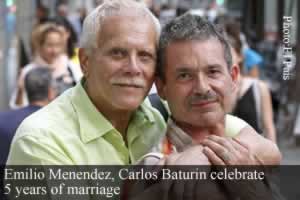
"Wooden" Anniversary for Spain's Gay & Lesbian Married Couples

The first gay & lesbian couples to tie the knot in terms of Spain's same s0x marriage law did so five years ago. If this were their fiftieth wedding anniversary, they could look forward to public celebrations and the traditional golden gifts for a golden anniversary. Instead, for just the fiffh anniversary, celebrations are likely to be more private, and the gifts (if there are any) are traditionally of wood. In the public sphere however, the country's LGBT community deserves to celebrate this minor landmark. When Spain's law took effect, they joined the Netherlands and Belgium as the only three European countries to provide full marriage equality. Today, the number of European countries in the club has more than doubled (seven) with more on the way.   

Spain's gay marriage law turned five on July 3. Passage of the law in the Roman Catholic nation turned Spain into a gay rights leader. Since then, 10,317 male couples and 5,063 female couples have married, 1.55% of the nation's total marriages, Madrid-based daily El Pais reported.
The Socialist government of Prime Minister Jose Luis Rodriguez Zapatero approved the law over the objections of the Catholic Church. Pope Benedict has called on Spanish Catholics to reject gay marriage.
In 2005, only three nations – the Netherlands, Canada and Belgium – had legalized gay marriage. Five years later, Sweden, Iceland, South Africa, and Portugal have joined in.
Lawmakers in Argentina will consider a gay marriage law on July 14.
Read the full story at "On Top

Friday, 2 July 2010

Marriage Equality, Costa Rica: Court Puts Referendum On Hold

In the US, the path to marriage has been bedevilled by tussles between courts, legislatures and citizens' ballot initiatives.  The key question: is it fair or constituionally acceptable to allow a majority to vote  away the rights of a minority? The high profile case here is that of California, with its protracted legal battle over Prop 8.


In Costa Rica, where the country was gearing up for a Prop 8 style referendum on gay marriage, there has been a new twist. Instead of waiting for the outcome and then trying to overturn it, a citizen has succesfully petitioned the constutional court to intervene and prevent the referendum going ahead. This is not a final decision -  this is just a restraining order while the constitutional court deliberates- but there could be promise here.


Costa Rica's Constitutional Court Orders A Stop To Same Sex Marriage Referendum

The Sala Constitucional (Constitutional Court) has ordered the Tribunal Supremo de Elecciones (TSE) to suspend the process of the referendum on same sex marriages that was to have been included in the December 2010 municipal elections.

The court order was based on an appeal filed against the referendum.

The Recurso Amparo (appeal) was presented by an individual identified only by the last names, Quirós Salazar, alleging that the referendum violates the rights and freedoms of individuals.

The referendum was to have let the population decide the fate of a proposal for law that would allow same sexmarriages in Costa Rica

Opponents to the referendum have argued that leaving the allowing the majority of the population (93%) which is heterosexual would be a constitutional violation of the 7% of the homosexual population.

The Quirós Salazar action argues that there are international declarations that make it clear that there be a respect for the rights of minorities.
The Court order orders the TSE to not continue with its efforts for the referendum while the magistrates of the Sala Constitucional consider the appeal.

Wednesday, 30 June 2010

In Vermont, 10 Years of Civil Unions

It is now 10 years since the start of legal recognition for same sex unions in Vermont, just 11 years after a comparable start in Denmark. For a time, both Vermont in the US and Denmark internationally were seen as remarkable exceptions: idiosyncracies in that were unlikely to be emulated in more mainstream states and nations. However, after some initial delay, and increasing number of others followed, and even upped the game. 


MONTPELIER, Vt.—When Lois Farnham and Holly Puterbaugh were joined in civil union 10 years ago Thursday, some of their friends didn't come for fear they'd lose their jobs, and the church asked that plainclothes police officers attend the ceremony in case there was trouble.
A decade later, Vermont and four other states—Massachusetts, Connecticut, New Hampshire and Iowa, as well as the District of Columbia—have instituted full marriage for same-sex couples, and the Burlington couple say many people view their relationship as "ho-hum."
Vermont was the first jurisdiction in the country to offer most of the legal rights and responsibilities of marriage to same-sex couples. Massachusetts instituted full same-sex marriage in 2004 in response to a state court's order. Last year, Vermont's Legislature became the first to approve full marriage for those couples without a court's prompting.
"At the time, civil unions were so radical," Farnham said this week. "Now it's the fallback, conservative issue."


What has been remarkable in recent years though, is how quickly, after the slow beginning, the idea has spread. In Europe, almost all countries have or are planning some form of provision for same sex partnerships, and seven have already upgraded to full marriage, with more on the way. In the US, early progress towards marriage equality was meet with a strong political backlash, but even here progress has been substantial and is accelerating.

Marriage Equality & European "Human Rights"

When two Austrian men, Mr Schalk and Mr Kopf, took their pursuit of the right to marry to the European Court of Human Rights, there were some hopes that this could mark a turning point for marriage equality across Europe. When the court turned down their application, the obvious response was one of disappointment. However, that would be too simplistic. The verdict was narrow, and not even necessarily final. Although the court left decisions on marriage equality to national governments, they did emphasize the importance of recognizing al families, including queer families, on an equal basis. As the Guardian explains, this may not have been the final decision on marriage equality for Europe, but it is an important landmark along the way:


"The right to marry remains subject primarily to national and not European law, but an Austrian couple have nudged the Council of Europe's 47 states closer to a consensus"
         Last week, the European court of human rights ruled unanimously that there was no obligation on states to recognise same-sex marriage. At least, not yet. Because hidden within the ruling are two significant findings that make it almost certain that one day the court will rule in favour of a right to have same-sex relationships – including marriages – recognised in law. The case is also notable for a bizarre intervention by the UK government, arguing against a right – to recognition of civil partnerships – that it had itself introduced at home.

Two Austrians, a Mr Schalk and a Mr Kopf, argued that the right to marry, set out in the European convention on human rights, requires states to recognise same-sex marriage. The court rejected that argument unanimously, stating instead that the right of men and women to marry is subject to national laws. The court relied on the fact that only six of the 47 European states recognise same-sex marriage (in fact, seven countries now do, with Iceland the latest). In this approach the court showed once more that on issues it calls "morality" it normally follows states, rather than leads them, an approach which those who accuse the court of "interfering" too much would do well to consider.
However, the court did state clearly that the right to marry does not apply only to persons of the opposite sex. The EU charter of fundamental rights – accepted by all EU states — guarantees the right to marry, deliberately excluding any reference to gender. This should mean that in those countries that grant access to marriage for all couples, any distinction between same-sex and heterosexual marriage would be arguable discrimination under the convention.   

(Read the full report at the Guardian)

Iceland's Gay Wedding for PM Sigurdardottir

In Iceland, legall recognition for same sex marriage has taken effect. I wonderful symbolism,
Johanna Sigurdardottir,the country's PM, was one of the first to tie the knot. She is now not only the world's first lesbian or gay PM, but also the first to have experienced for herself a gay wedding.


From the BBC:

Johanna Sigurdardottir, named as Iceland's prime minister on Sunday, is the first openly lesbian head of government in Europe, if not the world - at least in modern times.
The 66-year-old's appointment as an interim leader, until elections in May, is seen by many as a milestone for the gay and lesbian movement.
Up until now, if a gay man or woman has been prime minister, they have done their best to conceal the fact.
Iceland, however, has different standards for equality. When Sigurdardottir became PM, her sexuality passed almost unnoticed. When the gay marriage legislations was passed by parliament, it was accepted unanimously. 
What is really historic about this new cabinet, says Skuli Helgeson, the general secretary of Ms Sigurardottir's Social Democratic Alliance, is not the fact that its leader is a lesbian, but that for the first time in Icelandic history it boasts an equal number of men and women.

Saturday, 26 June 2010

Rally For Equality Law in Argentina

The Argentinian Lower House has already voted in favour of an equality law, which will allow for both the legal recognition of same sex marriage, and also gay adoption. The measure must still pass the Senate, where passage is not guaranteed. Senators are currently touring the country to try and take a sounding of the national mood, arguing that pressure in favour of equality is coming only from the metropolitan elites of Buenos Aires. To counter this activists are now taking to the streets in rural cities as well.

From On Top Magazine:


Thousands Rally For Gay Marriage In Argentina


More than 4,000 people rallied Thursday in Cordoba to urge the Argentine Senate to approve a gay marriage bill, various media outlets reported.
Demonstrators marched on the Plaza de la Intendencia, where they held banners, chanted slogans and listened to speeches in favor of making Argentina the first Latin American country to legalize marriage between two members of the same sex.
The bill was approved in May by Argentina's lower house, the Chamber of Deputies (la Camara de Diputados). The Senate General Law Committee reviewing the bill has taken its gay marriage debate on the road, with stops planned for the cities of Salta, Tucuman, San Juan and Mendoza. The four-city tour runs from June 14-28. The full Senate is scheduled to take up the bill on July 14, a Wednesday, where the measure faces an uncertain future.
Argentine President Christina Fernandez de Kirchner has said she would not block the measure from becoming law, if approved by senators.
Lawmakers in favor of gay marriage also spoke at the rally.
“Today nobody can say the existence of same-sex couples is abnormal,” Cordoba National Deputy Paula Cecilia Merchan told the crowd. “We are fighting, and I think we will ensure that the law is approved, so that these couples are recognized in the same way heterosexual couples are. In that sense, I think this fight has more to do with reality and cultural and social conditions.”